| |
|||||||||||||||||
| |
|
|
|
|
|
|
|
|
|
|
|||||||
| Get Free 70 Page SuperGuide. Sign up for Creative Studio (CAFE) magazine. |
Welcome to the PhotoshopCAFE Photoshop CS4 Learning site
What's on the CS4 Videos? Photoshop CS4 Content Aware Scale Photoshop CS4 GPU features Photoshop CS4 Retouching tools Photoshop CS4 Window Management Exclusive Interview with John Nack - Principle Product Manager: Photoshop. I was recently at Adobe Headquarters and managed to catch John Nack for an interview. John is the principle Product manager for Photoshop. John was kind enough to take a few minutes out of his busy day (Actually he gave me about an hour). Thanks John! When you launch Photoshop CS4 for the very first time, something is totally in your face. Yes, it sports a brand new interface. Over at Adobe, they have decided it’s time for Photoshop to be easier to use and make the tools you need within reach. Performance improvements The new view features are really great. Be warned that if you don’t have a video card with GPU (Graphics Processing Unit) you won’t have access to them. An easy way to tell is to look at the lower right corner of your document. If you see a drop shadow, you are good to go otherwise you are almost out of luck. Yes, there is hope, you can get a video card and add it to Birds eye view When you are zoomed into the image and want to move around, press and hold the H key. Click with your mouse and you will zoom out. Reposition the viewing rectangle and it will zoom back in to the new location. This is a super fast way to get around your document. It’s called Birds Eye view and is amazing fast. Brush Improvements I think by now you’re starting to see the improvements that GPU processing in CS4 gives you. On top of that we get a new brush engine, which is faster and smoother, especially when working with a graphics tablet. You will also notice a new brush preview, and wait for it, a new way to resize brushes by dragging in the doc. On the Mac hold down Control+Alt (Windows Alt+Right click) click and drag and you will see the brush tip change size. Drag to the left or right to change the size. Choose Control+Alt+Cmd (Ctrl + Shift on Windows) to change the softness. 32bit tone-mapping in HDR Tonemapping in HDR also gets a boost from the GPU and makes for smooth and speedy adjustments in the exposure adjustment. Sadly, there are no other improvements with HDR tone mapping. Interface
On the Mac there is an optional new application window. This enables users to float the entire application. This now allows users to drag the entire Photoshop application to a second monitor or to use the program without the desktop showing through. Tabbed Documents Borrowed from apps such as Flash, Photoshop now has tabbed document windows. This allows you to manage your working space without document windows spread everywhere. There are options in the new Application Bar which allow you to tile the windows in different ways, or to float them just like in previous versions of Photoshop. New Panels Palettes are now called panels across the suite, not just in Photoshop. You’ll see some inspiration from Lightroom in this release. All the panels have been redesigned and there is the addition of a couple of new ones; Adjustments and Masks panels. Don’t worry though; most of the panel behavior is the same as CS3. Adjustments panel One of the biggest changes in CS4 is the addition of the Adjustments Panel. Adobe is using the modular concept from Lightroom. Instead of opening a bunch of dialog boxes, you can now work with adjustments from a centralized panel. This means all of Photoshop’s functionality is available while making image adjustments. This is way easier and faster than before. A few users are yet to discover adjustment layers, now’s your chance to switch. The beauty of this is that all the image editing is non-destructive. Shadow/Highlights and Variations still need to be applied as smart filters, but there is an addition of the new Vibrance adjustment. Vibrance made its debut in Lightroom. Sadly, the clarity slider didn’t make its way across. (These are accessible from Camera raw which also works on jpg and tiff images – launched from Bridge). To make an adjustment, simply choose the desired tool from the adjustments panel or use the option at the bottom of the layers panel like before. The difference is that a dialog box doesn’t open. You can make all the changes with sliders right in the panel. There are also options in the panel such as clipping to a single layer.
The Adjustments panel allows you to select an adjustment. Once selected, its options take over the Adjustments panel so you can adjust without opening any dialog boxes. When done, click the left facing arrow, to return to all adjustments.
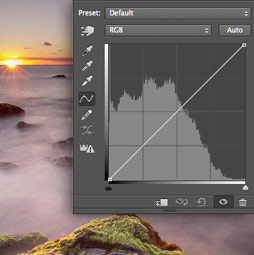
A really useful addition to the Adjustments panel is the ability to easily save and use presets. Sure you could save your settings in the past, but it was so obscure it wasn’t really useful. All that has changes, it’s now really easy to create and apply presets. TIP:Typically an adjustment layer will affect the entire layer stack. At the bottom right of the panel is an option, which affects only a single layer. It does this by adding the adjustment as a clipping group to the layer directly beneath it. This even works on masks, so get your creative thinking caps on! Masks Panel
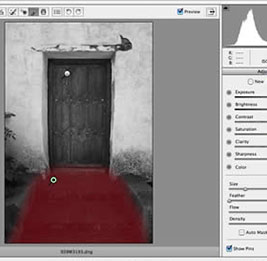
![]() ![]() ![]() ![]() The Masks panel: (Top) A basic mask created to show the red layer through the windows and door. Click and Drag In Photoshop CS3, a new behavior was added to the black and white adjustment (If you didn’t know, now you do). You can click and drag on an image to adjust the underlying tones. This Lightroom inspired feature is now in the Hue Saturation and curves adjustments. Click the little icon and drag on the image to make color and tone adjustments, that’s slick! Clone Stamp preview The Clone Stamp tool has enjoyed a little bit of a tweak. If you have ever seen the brush previews in Vanishing point, you will have noticed that the brush tip shows what it’s going to paint. This is called a clipped preview. We now have the clipped preview on the Clone Stamp; this allows us once and for all, to perfectly align things while cloning. All the usual comforts such as size and opacity controls are included. Spring loaded keys Here is a tiny, but useful change. Something called Spring Loaded keys. How many times have you been using a tool and need to temporarily switch to a different tool? Rather than tapping a keyboard shortcut for the tool, hold the key, use the tool, then release the key and you go back to the previous tool. For example, you’re working with the brush tool and need to make a quick selection. Hold the M key, make the selection, release the key and continue painting around the new selection. Now is a good time to learn all the tool shortcuts! Auto align When using the Auto-align tool you’ll find some minor tweaks. The first is an automatic fisheye correction. Photoshop will read the metadata and if it finds a supported lens, it will compensate for it while building seamless panoramas.
These lenses should be supported with all Canon and Nikon DSLRs. Vignette correction When making panoramas you can also compensate for lens vignette (less light makes it to the edge of the lens, therefore the edges of the image are darker). This makes the panoramas more seamless without dark edges on each photograph. Color Range One of my favorite tools for making selection is Color Range. I always had problems with it being too greedy and grabbing colors from all over the image. It now has a new spatial tolerance with Multiple color clusters. What? Ok, in English: Color range has always selected by the how close the colors are from each other. Now it can be constrained to physical distance too, so you don’t have to select a color all over the image, just within a certain distance that you choose with the new Range slider which appears when you turn on the Localized Color Clusters option. Color Range used to select the blue boat in the photo. Retouch tools The Sponge tool has the addition of the vibrance control as an alternative option from saturation. Vibrance first found its way into the Adobe world through Lightroom. It’s now in Camera Raw and as an Adjustment layer. Vibrance works like saturation except if avoids clipping colors. When a color is dull it gets adjusted more than an already bright color, quite nifty really. The Dodge and Burn tools have also been tamed a little and are a lot more usable than they were in the past. They now affect just the tone without messing with the colors. Content aware scale Probably the sexiest looking feature in Photoshop CS4 is the Content aware scale. When you transform an image vertically or horizontally, usually it ends up with a squashed looking distorted image. When you turn on Content Aware Scale, it looks for the most important parts of the image and maintains their shape while squishing everything else. It looks just like a magic trick! If Photoshop can’t figure out the important parts of the image, you can paint on a channel to tell it. There is also a protect skin tones button, which prevents skin toned people from getting distorted.
![]() ![]() ![]() ![]() Gestures on Mac! I had to try it for myself to believe it! Yes! For those of you who have a newer MacBook pro, be happy. Those little pinch to scale gestures (ala iPhone) now work in Photoshop. That’s just so cool! So cool in fact, it works in Bridge too! You can also scroll and rotate with the use of 2 fingers. Flash panels
Adobes definition of Kuler: With Kuler, you can easily generate color themes that can inspire any project. Whether you’re creating web sites, in¬terior designs, scrapbooks, fabric patterns, graphic identities, or any other piece of visual communication, you can ex¬periment quickly with color variations. You can also fast search by tag word, title, creator, or hex color value through thousands of themes created by the Kuler community. Connections: The Connections panel helps you manage all your Adobe accounts. It can log you into Adobe.com services (Kuler and ConnectNow) as well as check for updates and new panels. Extra panels
Connect- now
Annotations The little notes have been improved. You now have a panel for displaying their contents. Much easier to work with, plus you can now export the contents as a text document. Audio annotations are gone. Yes, they had audio annotation, see; no one used them, that’s why they are gone. Read Up on the Extended features of CS4 See a Grid of all the Suites and CS4 Products Whats in the Suites?
Comprehensive Photoshop CS4 Training Video by Colin SmithAnnouncing new CS4 video, by Colin Smith. Photoshop Secrets: Photoshop CS4 for Digital Photographers, All new for the 4th edition of the best-selling DVD. 49 Lessons, 6.25 hours! Now shipping!
Colin Smith is a best selling author, digital artist, speaker and creates popular training videos. He is founder of PhotoshopCAFE.com. |